Amatullah Mahiya: A Premium Script for Authentic Design
There is a specific kind of challenge in design that involves balancing elegance with legibility. We often see script fonts that look beautiful in isolation but become a nightmare to read when applied to a product label or a logo. Finding a typeface that maintains that high-end, calligraphic aesthetic without sacrificing usability is rare. This is where Amatullah Mahiya enters the conversation. It is not just another cursive typeface; it is a carefully crafted premium script font designed to bridge the gap between artistic flair and commercial functionality.
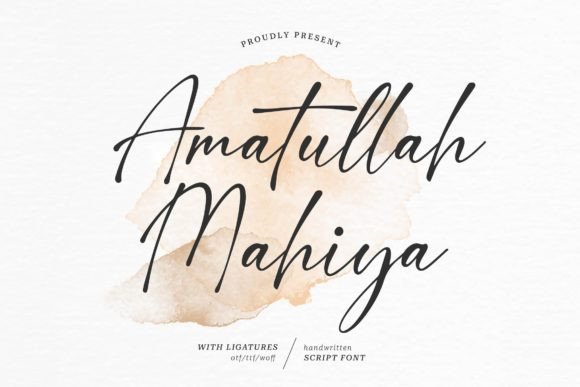
When you look at the anatomy of Amatullah Mahiya, you immediately notice the fluidity of its strokes. It mimics the natural rhythm of hand-lettering, offering a personality that feels organic rather than mechanical. The font carries a modern calligraphy vibe, characterized by sweeping tails and distinct swashes that give it movement. However, unlike many decorative scripts that rely heavily on ornamentation, this typeface maintains a clear structure. The x-height is generous enough to ensure that lowercase letters remain distinct, and the spacing between characters is calibrated to prevent the "clumping" effect that plagues so many script fonts. It feels personal and intimate, making it an excellent choice for projects where you want the viewer to feel a direct connection with the message.
The Role of Amatullah Mahiya in Brand Identity
Typography is one of the silent architects of brand perception. The font you choose for your logo or packaging speaks volumes before the customer even reads the text. Using Amatullah Mahiya in a branding context sends a clear signal of sophistication, care, and artisanal quality. For businesses in the lifestyle, beauty, fashion, or hospitality sectors, this font can act as the cornerstone of a visual identity that feels luxurious yet approachable.
Consider a small business owner launching a line of scented candles or organic skincare. The product is tactile and sensory. Using a rigid, geometric sans-serif font might feel too cold or corporate, failing to capture the warmth of the product. Conversely, a standard serif might feel too traditional. Amatullah Mahiya offers that "sweet spot." It looks stunning on packaging design, particularly for the logo or the product name. It elevates the perceived value of the item, turning a simple label into a piece of art. When applied to the front of a shopping bag or printed on a tissue paper wrap, it reinforces the brand's commitment to detail and quality.
Visual Hierarchy and Readability
A common mistake in using script fonts is applying them to body text. Amatullah Mahiya is a display font at its core, meaning it is designed to be the hero of the layout, not the supporting cast. It works best for headlines, sub-headlines, and call-to-action statements. When used correctly, it creates a strong visual hierarchy.
For instance, in editorial design or a blog layout, you might pair Amatullah Mahiya with a clean, minimalist sans-serif font for the body text. The contrast between the expressive script and the neutral sans-serif guides the reader’s eye naturally. The script captures attention and conveys the mood, while the sans-serif delivers the information efficiently. This pairing strategy is essential for web design as well. While Amatullah Mahiya is excellent for website hero sections or quote graphics, body text on a screen requires high legibility at smaller sizes, which is best served by a sturdy serif or sans-serif typeface.
Practical Applications Across Creative Projects
The versatility of Amatullah Mahiya extends far beyond corporate branding. Its aesthetic makes it a favorite for personal projects and specific commercial applications. Here is a breakdown of where this font truly shines:
- Event Stationery: For wedding invitations, save-the-dates, and greeting cards, the font provides an immediate sense of formality and romance. It mimics the look of custom hand-lettering without the high cost of hiring a calligrapher for every single invitation.
- Apparel and Merch: On t-shirts, tote bags, and mugs, the font’s flow works well with curved layouts. It avoids the stiffness of block letters, making merchandise look trendy and boutique-style.
- Digital Content: Social media graphics rely heavily on stopping power. Whether it is an Instagram quote, a Pinterest pin, or a YouTube thumbnail, using Amatullah Mahiya can make the text feel artistic and shareable.
- Photography Watermarking: Photographers often struggle to find a watermark that doesn't ruin the image but still protects their work. This font is delicate enough to sit over a photo without dominating the scene, yet distinct enough to claim ownership.
Evaluating Font Pairings and Technical Fit
Choosing a font is rarely a solitary decision; it is about how it interacts with other design assets. Amatullah Mahiya pairs exceptionally well with modern sans-serif fonts. Think of typefaces like Montserrat, Lato, or Bebas Neue. The geometric simplicity of these fonts complements the organic curves of the script.
When evaluating the technical fit for your project, it is important to look at the specific features included with the font. High-quality premium fonts often include stylistic alternates and ligatures. These are variations of specific letters that activate automatically or manually to ensure the text flows naturally, avoiding awkward collisions between letters like 'o' and 'n', or 'b' and 'y'. Checking for these features in Amatullah Mahiya allows you to fine-tune your typography for a truly custom look.
Licensing and Commercial Use
For entrepreneurs and freelancers, understanding the license is just as critical as the design. Amatullah Mahiya is a commercial font, which implies that using it in client work or on products for sale requires the appropriate license. Always review the End User License Agreement (EULA). If you are designing a logo for a client, you generally need to ensure the client has the rights to use that font in their final application, or you must convert the text to outlines (paths) for logos to avoid them needing the font file. However, for physical goods like printed mugs or t-shirts, specific extended licenses might be required depending on the volume of sales.
Conclusion: Elevating the Everyday
In a crowded market, the details matter. The difference between a design that looks "homemade" and one that looks "professionally crafted" often lies in the typography. Amatullah Mahiya is more than just a collection of vector points; it is a tool for storytelling. It allows designers, bloggers, and business owners to inject personality and warmth into their projects. Whether you are labeling a jar of homemade jam or designing a high-end fashion lookbook, this font provides the flexibility and elegance needed to make your work stand out. By understanding its strengths and pairing it effectively, you can use Amatullah Mahiya to create designs that are not only beautiful but also deeply resonant with your audience.